

Can ChatGPT Cite My Website?
If you run a website, publish blog content, or care about organic traffic at all, you’ve probably wondered: can ChatGPT actually cite your website?
The short answer is yes. But the real answer is more interesting than that.
Because what most people are really asking isn’t whether ChatGPT can cite a website — it clearly can. The better question is why some websites show up in AI answers while others never do. That’s where things get practical.
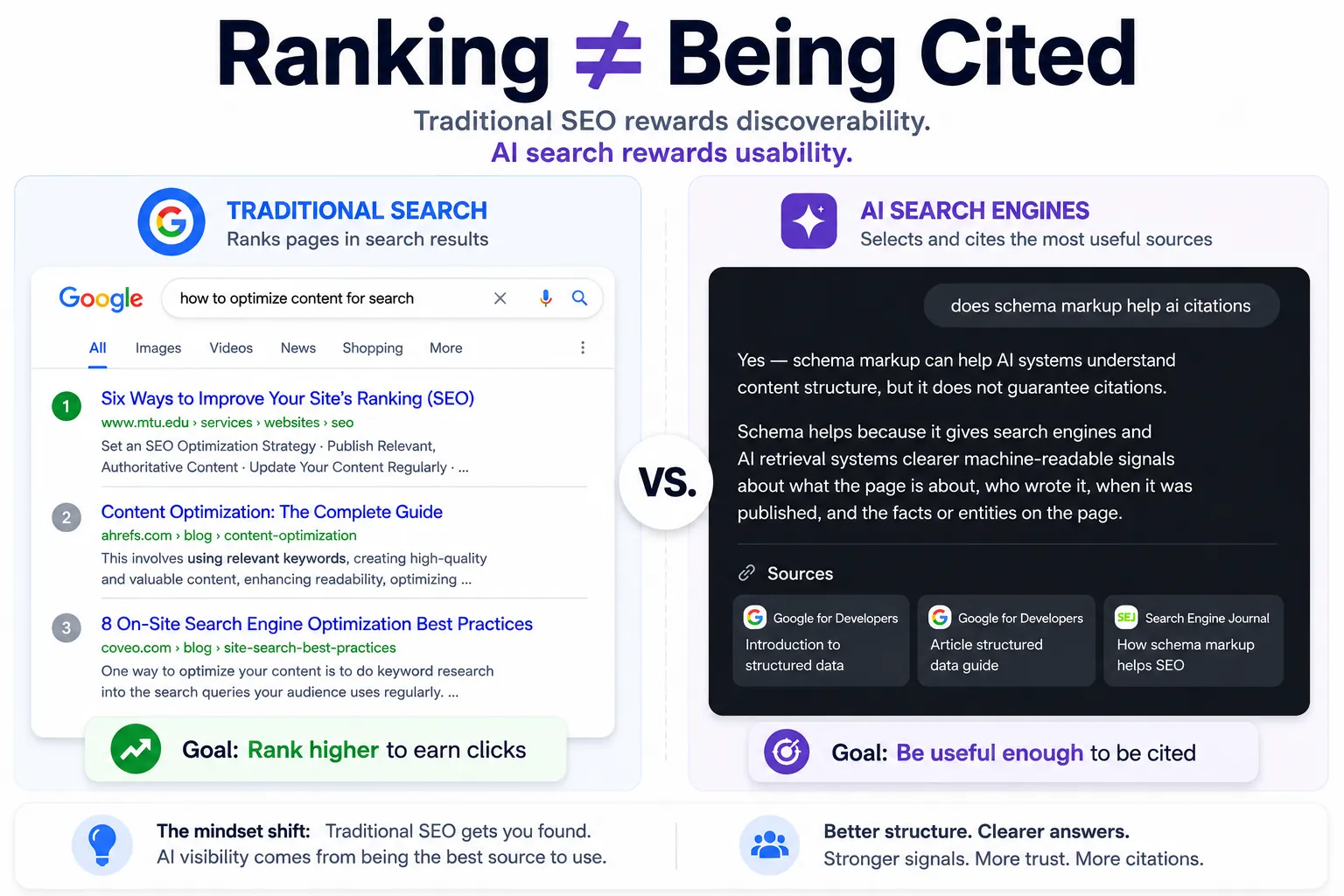 Ranking well in Google does not automatically make content a strong citation candidate for AI search engines like ChatGPT, Perplexity, and Gemini.
Ranking and being quotable aren’t the same thing
A lot of people still think AI visibility works like traditional SEO with a different logo slapped on top. Rank in Google, build backlinks, publish enough content, and eventually the traffic comes. Some of that thinking still applies, but AI search introduces a different layer.
Ranking well and being useful enough to quote are not the same thing. A page can rank reasonably well and still be a terrible source for an AI-generated answer.
You’ve seen content like this before — articles that technically look polished but manage to say almost nothing for the first several paragraphs. The kind of writing filled with phrases like “in today’s rapidly evolving digital landscape” that sound important until you actually read them.
Humans hate that kind of content. AI systems probably don’t love it either. If a tool like ChatGPT is assembling a useful answer quickly, content that gets to the point has a natural advantage over content that hides the answer behind fluff.
The mindset shift happening right now
For years, SEO conversations focused heavily on discoverability. Can search engines find your page? Is it relevant enough to rank? Does the domain carry authority?
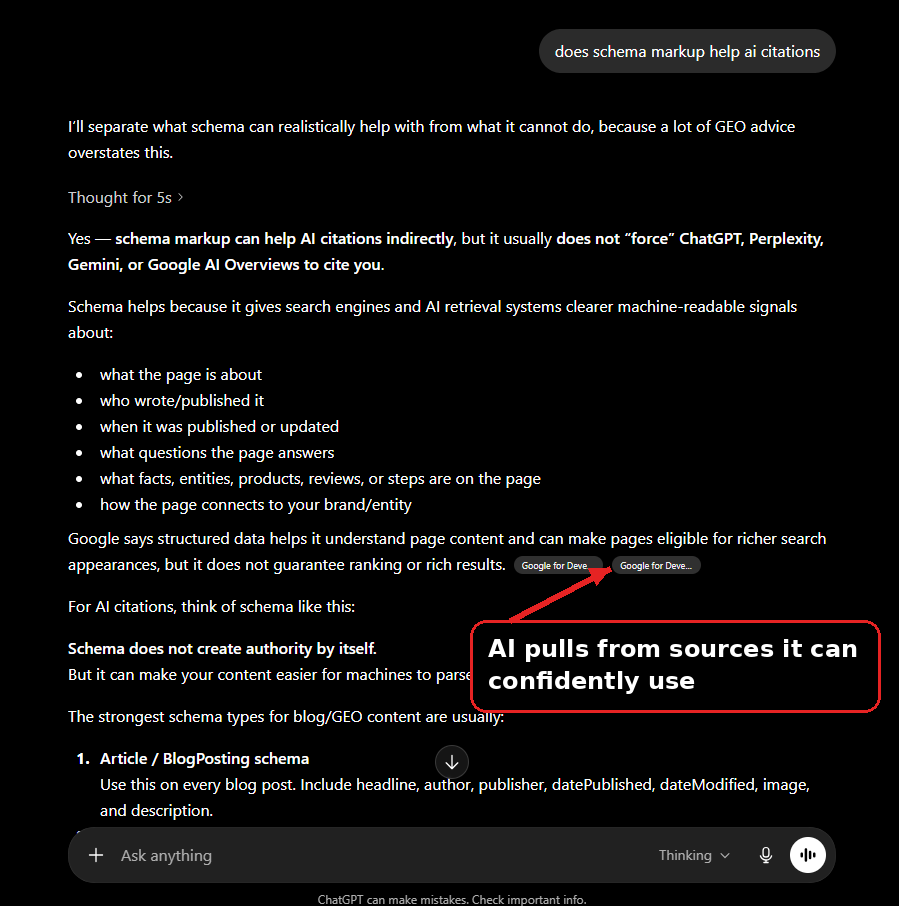 Example of AI selecting source material it can confidently use when generating answers.
Those questions still matter. But AI citation introduces another one: if a machine lands on this page, is there actually something usable here?
That changes things. A smaller site with cleaner, more direct writing can sometimes be a better citation candidate than a bigger site publishing vague filler under a powerful domain.
That doesn’t mean authority stopped mattering. It absolutely still does — trust matters, reputation matters, technical accessibility matters. But clarity matters more than many site owners realize. And that’s encouraging, because clarity is something you can actually improve.
Two different conversations people keep mixing up
One thing worth clearing up: people often blend two completely different conversations when they ask whether ChatGPT “uses” their website.
One conversation is about model training — whether your content was part of the data a model learned from. The other is about live citation visibility — whether your page appears as a visible source in an AI-generated answer.
If you’re a publisher, blogger, SaaS founder, affiliate marketer, or content team, the second one is usually the practical concern. Can your website appear as a cited source in ChatGPT’s search results or AI answers?
Yes. That opportunity exists. But if your content is generic, hard to interpret, structurally messy, or thin on trust signals, you make that opportunity smaller.
You don’t need a secret formula
Nobody outside OpenAI knows the exact internal decision-making behind every citation. Anyone claiming they’ve reverse-engineered the full formula should make you skeptical.
But you don’t need insider knowledge to notice the practical patterns:
- Content that answers questions directly tends to be easier to quote.
- Content with clear headings tends to be easier to interpret.
- Content that looks trustworthy tends to feel safer to surface.
- Content that rambles tends to lose.
That isn’t magic. It’s usability.
This is also why a lot of AI search optimization advice feels overcomplicated. Some people talk about generative engine optimization like it’s an entirely new discipline requiring hidden tricks. In reality, a big part of it comes down to writing content that is genuinely useful — useful to humans, useful to machines, useful enough to be surfaced without embarrassment.
Where a readiness check fits in
That’s part of the thinking behind AI Citation Checker. Not because any tool can perfectly predict whether ChatGPT will cite a specific page tomorrow — that would be a ridiculous claim. But because it’s possible to evaluate whether content looks structurally ready for AI citation, based on patterns that consistently make pages easier to trust, understand, and quote.
If you’ve ever wondered why one article gets surfaced and another gets ignored, that’s a far more useful place to start than chasing imaginary secret formulas.
So yes — ChatGPT can cite your website. The better question is whether your content gives it a good reason to.